
The Government says Ghana’s oil palm revival will be driven by improving smallholder farmers’ productivity and incomes, as part of efforts to reduce the nation’s reliance on imported palm oil.
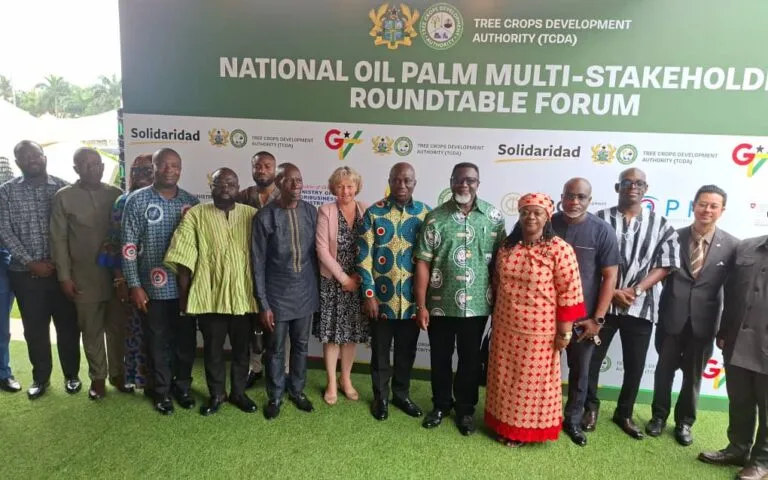
At the National Oil Palm Multistakeholder Roundtable Forum in Accra on Wednesday, the Minister for Food and Agriculture, Eric Opoku, explained that the programme targets the establishment of 100,000 hectares of new oil palm plantations. He stressed that the focus will not only be on expanding land under cultivation, but on increasing yields, strengthening farmer support systems, and improving linkages between production and processing.
According to the Minister, the success of the initiative will be measured by how much farmers can boost output and earn better incomes, noting that Ghana has previously developed policies and carried out studies, but the priority now is turning commitments into practical programmes with clear responsibilities and measurable results.
Mr Opoku said oil palm remains a major economic crop, supporting jobs across the value chain—from nursery operations, transport and processing to trading and manufacturing. He added that palm oil and its derivatives are used in the production of products such as soap, cosmetics, pharmaceuticals, confectionery, animal feed and bioenergy, making it an important source of industrial raw materials.
He said smallholder and outgrower farmers will need access to improved planting materials, certified nurseries, extension services, and modern farm management techniques to achieve higher yields. The Minister also called for stronger market arrangements to ensure reliable buyers, transparent pricing, affordable inputs, and fair shares of value along the entire production and processing chain.
Mr Opoku further noted that women and young people must be intentionally included in opportunities across production, aggregation, processing, logistics, technology, and other oil palm-related enterprises.
He warned that Ghana’s dependence on imported palm oil represents lost opportunities for farmers, employment creation, and foreign exchange earnings. He also cautioned that domestic supply shortages could fuel smuggling and unfair competition, harming legitimate businesses and government revenue.
The Minister said boosting local production would help Ghana retain more value within its economy and strengthen its ability to compete in regional and international markets.
Speaking at the forum, the Chief Executive Officer of the Tree Crops Development Authority (TCDA), Dr Andy Osei Okrah, said the new national policy is expected to formalise palm oil production and provide a framework for industry regulation. He noted that TCDA has been designated as a key regulatory institution responsible for licensing, production planning, and data management within the tree crops sector.
Dr Okrah added that effective regulation and formalisation would improve coordination, strengthen investment confidence, and create a more structured environment for growth by ensuring that all actors across the oil palm value chain are properly regulated.
The Minister also highlighted that formalisation should not be viewed as an administrative burden, but as a pathway to increased credibility, better access to investment, and opportunities in premium markets.
He identified challenges such as access to land and affordable, patient financing due to the long gestation period of oil palm. He said financial institutions should develop suitable financing products for farmers, nurseries, aggregators, and processors. Traditional authorities, landowners, and local authorities, he added, must promote transparent land arrangements that protect communities and reduce disputes.
Mr Opoku stressed that Ghana also needs investment in processing facilities, storage, transportation, quality control, and reliable off-take systems. He said the country must move beyond producing fresh fruit bunches to producing finished and value-added palm products for both local consumption and export.
While advocating expansion, he cautioned that the programme must protect forests and environmentally sensitive areas, and that productivity gains should come from both better management of existing plantations and expansion into suitable new areas. He said environmental responsibility and traceability are increasingly important requirements for international markets.
The Minister concluded by calling for coordinated action among government agencies, research institutions, financial institutions, development partners, farmer organisations, traditional authorities and private investors. He said Government will create the enabling policy environment and provide strategic public investment, while the private sector is expected to drive capital mobilisation, technology, innovation, efficiency and market access.
Ultimately, he said the “reset” of Ghana’s oil palm sector will be reflected in higher farm productivity, certified nurseries, efficient processing facilities, new businesses, decent jobs, increased domestic palm oil production, and reduced imports.